 Social Innovation Forum
At the beginning of June, the Social Innovation Forum (SIF) team attended GEO’s 2026 National Conference, held in partnership with Philanthropy Massachusetts. The event’s theme: Transforming Philanthropic Culture and Practice — exploring effective grantmaking in service of nonprofits and alongside communities leading equity-informed social change. The conference offered actionable tools, ideas and connections to help grantmakers strengthen practice inside and outside their organizations.
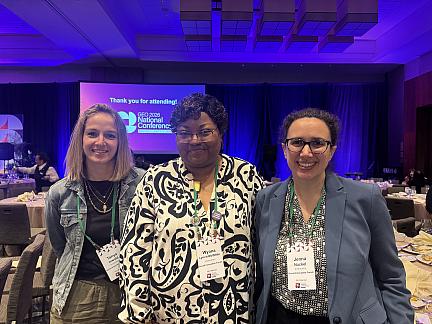
From left to right: Director of Programs Tanya Inwald, Executive Director Wyona Lynch-McWhite, and Director of Network Engagement Jenna Nackel shared their thoughts about the conference during a recent conversation.
What were your first impressions of the conference?
TANYA INWALD: This was my first time attending the conference, and I appreciated the combination of practical ideas for clear, effective action, opportunities to connect with and learn from others, and dedicated time to pause and focus on the positives.
WYONA LYNCH-MCWHITE: This was not my first GEO gathering so I had an idea what to expect. The conference was a great opportunity to connect with funders and other intermediaries across the country who are committed to positive social impact in a variety of ways. I love that SIF has a place within the GEO community and that there was a strong focus on capacity building and collaboration throughout the conference sessions and I loved being able to share our local community with the attendees.
JENNA NACKEL: During a moment of such need for our sector and our communities, it was at times a bit of a weird feeling to be at a conference with 1,000+ people who are responsible for directing philanthropic resources taking a few days to slow down, reflect, and learn. Don’t get me wrong: the conference wasn’t totally disconnected from community needs. For example, I went to a session called “Listening in Chaos: Practical Skills for Responsive Philanthropy” facilitated by Feedback Labs, which shared tools for high quality listening in crisis contexts and ideas for soliciting feedback without overburdening nonprofits.
What did you find most interesting or valuable?
TANYA: Working at the intersection of funders and nonprofits, I found it particularly interesting to hear directly from funders about some of the challenges they face and the ways they work to address them.
WYONA: The community is amazing and it was great to see our colleagues from several CORE organizations in attendance. Beyond that, the case studies that were shared during sessions were really interesting. Seeing how different community partners came together, both nonprofits and funders, to support leaders in certain areas or to work on specific issue areas were illustrative and the session Q&A’s helped provide so much information on lessons learned. It was great to be a presenter for a session with our colleague at Nonprofit Finance Fund (NFF) but I also wanted to be in three other sessions that were also about capacity building that were taking place at the same time.
JENNA: My main takeaway from GEO was the value of meeting others who do similar work and learning about their challenges and strategies. While the sessions themselves were great, I found the networking most valuable. Attending someone else’s event and experiencing this reaffirmed our approach at SIF — that our workshops and learning cohorts do offer participants new resources and skills, but also a network of other people to connect with.
What did you learn at GEO that either reinforced SIF’s existing approach or gave you a new idea worth exploring?
TANYA: I attended several sessions focused on capacity building, where participants discussed different approaches to strengthening grantee capacity. It was encouraging to hear that SIF has already been implementing and promoting many of the strategies highlighted, including reducing reporting requirements, prioritizing conversations over written reports, and providing multi-year unrestricted funding.
WYONA: One of the keynote speakers shared that they saw their organization as a “power building organization” which was a wonderful framing as we think about the urgent needs across the sector. That comment and many of the sessions gave me many seeds to consider as we shape the next phase of SIF and our strategic planning journey. Narrative Illustration, shared learning, systems change, and examining our relationship to “this time of rupture”; there were so many ideas to explore and to do so as leaders in the work with both love and courage.
JENNA: What I heard at GEO affirmed many of our feedback and data collection practices at SIF, and I felt stretched to continue improving too. For example, how can we use existing data sources or collaborate with our partners to collect data with less burden on nonprofits? Ultimately, I came to appreciate the value of time for reflection and learning for funders. I also left the event remembering that nonprofit leaders need that too — now, more than ever, when things are urgent and high-stakes. Those with positional privilege and resources, like the funders who gathered for GEO, are responsible for stewarding those resources in a way that makes it possible for nonprofit leaders to find that space and time to breathe.